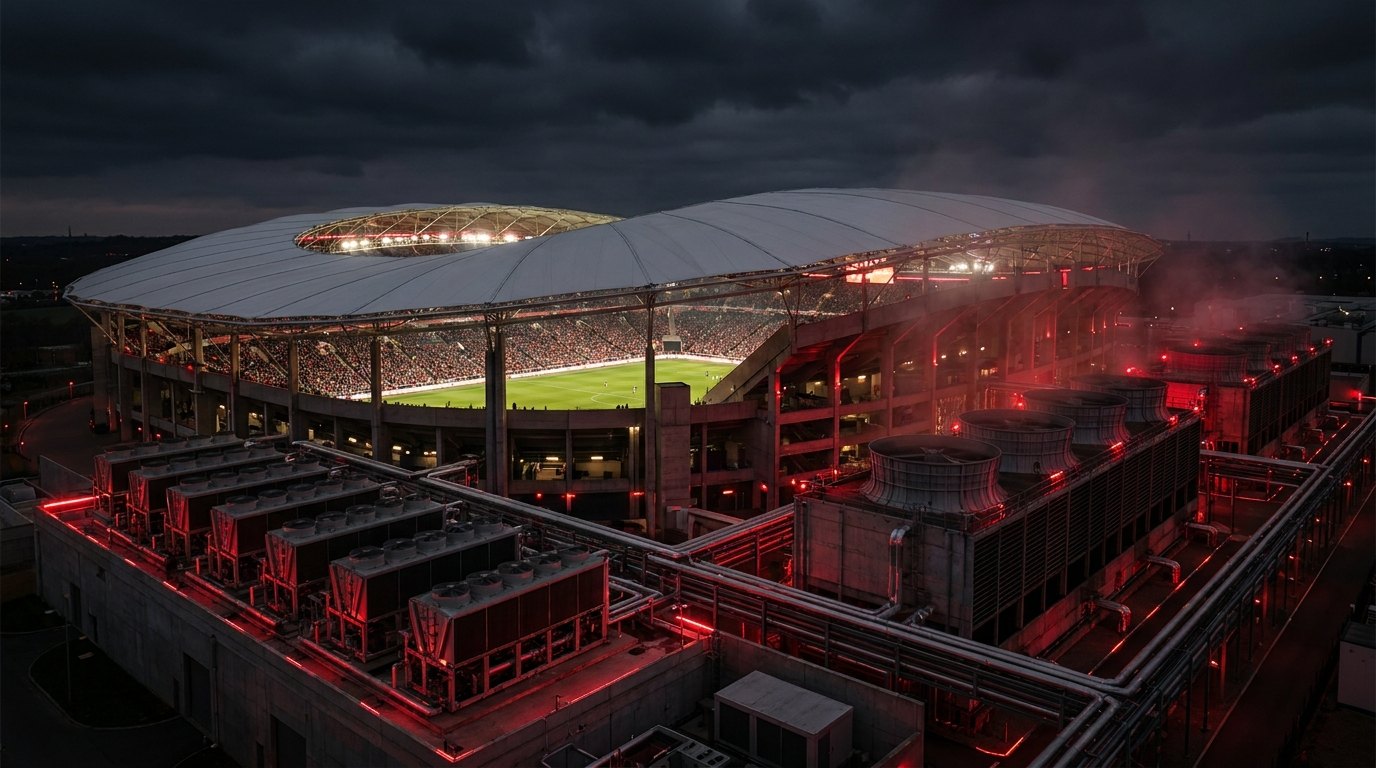
The 2026 World Cup has landed in Miami, and Hard Rock Stadium — temporarily renamed Miami Stadium for the tournament — is hosting seven matches for crowds of up to 65,000. So how much air conditioning does it take to keep a venue that big comfortable? For a fully enclosed dome, the answer is staggering: 8,000 to 15,000 tons of cooling, enough to air-condition a couple thousand homes at once. Hard Rock, though, is open-air — its 14-acre canopy shades fans but the bowl is open to the sky, so its mechanical plant works hardest on the enclosed spaces: suites, club lounges, locker rooms, kitchens, and back-of-house. The surprising part? The physics that cools a stadium is the same physics that cools your house. Only the scale changes — and that is exactly the range ABC Mechanical works across.
The World Cup is in South Florida — and so is the heat
Between June 15 and July 18, 2026, Miami is one of the marquee host cities of the FIFA World Cup. Hard Rock Stadium in Miami Gardens — operating under the tournament name "Miami Stadium" — is staging seven matches: four group-stage games, a Round of 32, a quarterfinal, and the third-place playoff, drawing crowds of as many as 65,000 fans into the South Florida summer.
Which raises a question any HVAC contractor in this market thinks about instinctively the moment 65,000 bodies fill a building in July: what does it actually take to keep a place like that cool? The answer is a useful lens on cooling at every scale — because the same laws of physics that govern a stadium also govern the condo, the office, and the house down the street.
What a "ton" of cooling really means
First, the unit. In HVAC, a ton is not a measure of weight — it is a measure of cooling rate. One ton equals 12,000 BTU per hour, a figure that dates back to the cooling power of melting a ton of ice over a day. A typical South Florida home runs on roughly 2 to 5 tons. A large office floor might need dozens. A stadium runs into the thousands.
Put that in perspective: an 8,000-ton cooling plant removes about 96 million BTU of heat every hour — the rough equivalent of air-conditioning around 2,000 to 2,300 average homes simultaneously. That is the kind of capacity major enclosed stadiums are built around.
The numbers behind a climate-controlled stadium
For venues that fully enclose and condition the seating bowl, the cooling demand is enormous. Industry figures put a domed, climate-controlled stadium somewhere between 8,000 and 15,000 tons of cooling capacity, depending on size, roof type, and climate. A few real-world points of reference:
- NRG Stadium (Houston): with the roof closed, the building uses an average of about 8,000 tons of cooling to hold the whole bowl comfortable.
- University of Phoenix Stadium (Arizona): roughly 8,000 tons as well — described as enough cooling for about 2,300 homes.
- Levi's Stadium (San Francisco 49ers): built around 21 self-contained units sized up to 100 tons each, feeding suites, clubs, and conditioned areas.
These plants are built around large centralized chillers in mechanical rooms that chill water to very low temperatures, then pump it throughout the building to air handlers that blow cooled, dehumidified air into the space. It is the same chiller-and-cooling-tower architecture we describe in our deep dive on how a large building beats a South Florida summer — just at the largest scale most cities ever build.
The Hard Rock twist: an open-air stadium cools differently
Here is where Miami's venue is genuinely interesting. Hard Rock Stadium is not a climate-controlled dome. Its defining feature is a 14-acre shade canopy — a structure weighing more than 17,000 tons of steel, added in a roughly $500 million renovation — that keeps as many as 92% of fans in the shade and out of the rain while leaving the field and the bowl open to the sky. The canopy is not air-conditioned. It shades and it channels natural airflow; it does not refrigerate the seating bowl.
So where does Hard Rock's mechanical cooling go? Into the enclosed spaces that wrap the bowl and live beneath the stands — the luxury suites, club lounges, restaurants and kitchens, locker rooms, media and broadcast areas, offices, and back-of-house. Those are the rooms that have to stay genuinely cold and dry while tens of thousands of people generate heat and humidity just feet away. On match day, that conditioned envelope is doing real work even though the fans in the open seats are cooled the old-fashioned way: shade, breeze, and hydration.
Open-air doesn't mean low-demand. An open stadium shifts the cooling load rather than eliminating it. Concentrating it into suites, clubs, and kitchens — spaces packed with people, equipment, and cooking heat — creates intense, localized loads that punish any system without real capacity and humidity control behind it.
Why South Florida makes any venue harder to cool
Wherever the cooling happens — a full dome or a stadium's premium level — South Florida adds a degree of difficulty that the temperature alone never tells you. The hardest part of cooling here is not lowering temperature. It is removing water.
Cooling load comes in two forms. Sensible load is the heat you feel as temperature — sun, lights, electronics, bodies. Latent load is the energy needed to pull moisture out of the air. In our climate, latent load can be a third or more of the total, because every space constantly takes in hot, saturated outdoor air and gives off moisture from the crowd inside it. A packed suite isn't just warm — it is humid, and the system has to dry that air, not merely chill it. This is why a marginal setup feels clammy before it feels warm, with the thermostat reading a satisfied number while occupants quietly start to sweat.
A stadium and your house run on the same rules
For all the difference in scale, a 65,000-seat venue and a three-bedroom home obey identical principles:
- The same refrigeration cycle. A 3-ton home unit and an 8,000-ton stadium plant both move heat from inside to outside through compression and evaporation of refrigerant. The hardware is bigger; the physics is identical.
- The same humidity fight. Both have to dehumidify South Florida air, and both feel clammy and grow mold-prone when they can't keep up — which is also why an oversized system is a problem, not a luxury.
- The same enemy: neglect. Dirty coils, clogged filters, and low refrigerant quietly steal capacity from a stadium chiller and a closet air handler alike. Maintenance is what protects rated performance at any size.
- The same need to be sized right. Capacity matched to the real load — not a guess — is what separates comfort from a system that runs constantly and still loses.
That is the throughline: comfort is comfort, whether the building seats a crowd or sleeps a family.
Where ABC Mechanical fits — from stadium-scale to your street
ABC Mechanical works across that entire range. On the large-facility side, we service the chillers, cooling towers, large air handlers, pumps, and building-automation controls that keep institutional and commercial buildings comfortable on the worst afternoon of the year — the same class of systems that condition a venue's premium spaces, detailed across our commercial HVAC services and our high-rise capital-planning work. On the residential side, we handle AC repair, replacement, maintenance, and right-sized installation for homes throughout Fort Lauderdale, Miami, and the Palm Beaches.
So while the World Cup spotlight is on Miami, the takeaway is simple: the engineering that keeps a stadium comfortable is the same engineering that keeps your home comfortable — and ABC Mechanical does both. Enjoy the matches. If your own AC isn't winning its game against the South Florida summer, that part we can fix.