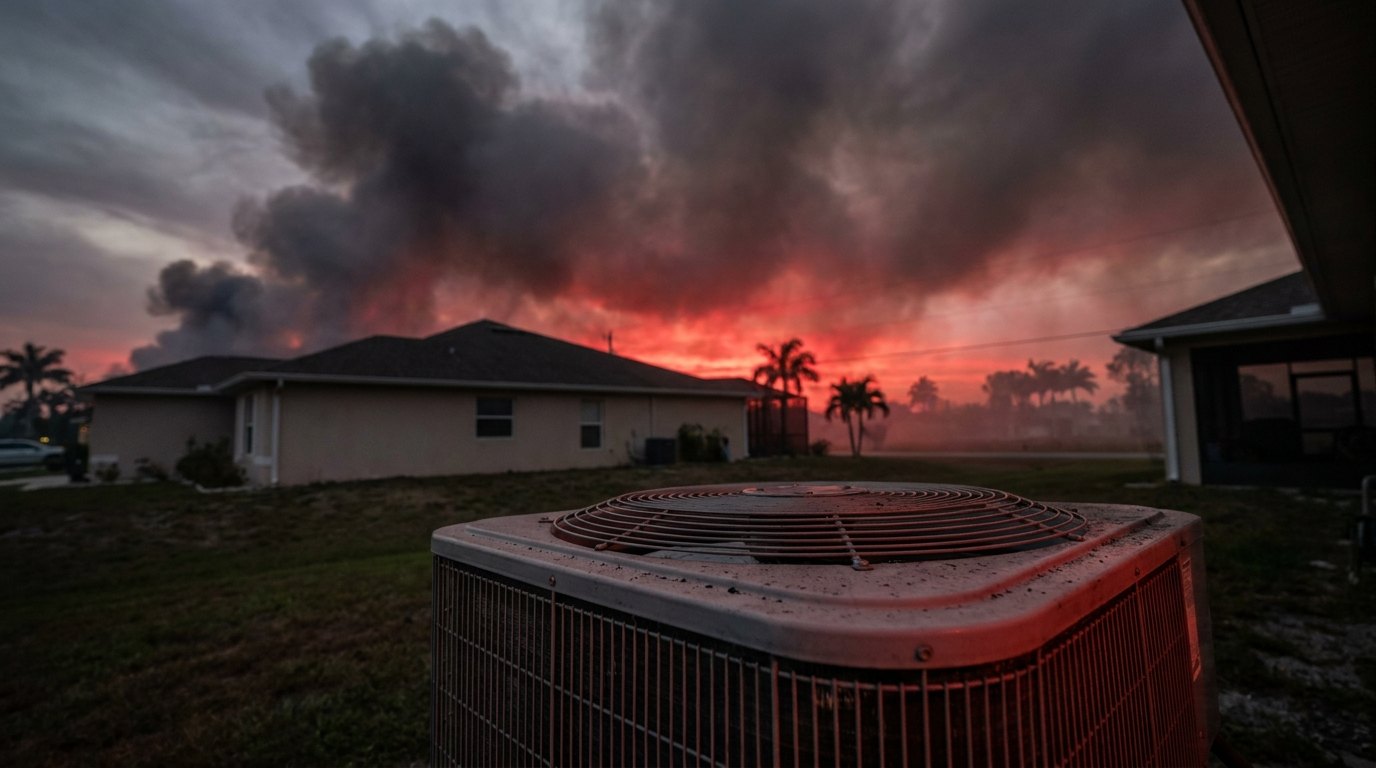
In June 2026, a string of wildfires west of Doral and Sweetwater burned through the Everglades edge — the largest, the Quarry 2 Fire, scorched about 17,200 acres — and pushed thick smoke and ash across Miami-Dade and Broward. Officials told residents to keep doors and windows closed and stay inside. What most people don't realize is that their air conditioner was on the front line: smoke and ash get pulled into the condenser, clog the filter, coat the coils, and load the ductwork — cutting capacity, raising bills, and leaving a smell that lingers long after the fire is out. The good news: the damage is largely preventable. During a fire, run on recirculate with a clean, higher-efficiency filter; afterward, change the filter and have the coils cleaned. Here's the full playbook.
What happened near Doral
Through mid-June 2026, multiple wildfires ignited along the western edge of Miami-Dade, near Doral and Sweetwater. By Friday, June 19, the Quarry 2 Fire had burned roughly 17,200 acres and was about 75% contained; a cluster of nearby fires — the Well Fire, the Coptic Fire, and a smaller West of A Fire — pushed the combined burn area to roughly the size of the city of Coral Gables. Crews worked around the clock, southbound lanes of Florida's Turnpike were closed to support firefighting, and some residents near the conservation area were told to evacuate.
You didn't have to live next to the flames to feel it. As CBS Miami reported, the smoke and ash drifted across South Florida, and Miami-Dade Fire Rescue's Erika Benitez put the health stakes plainly:
"Smoke can travel for miles impacting air quality. Smoke from brush fires contains small particles and some pollutants that can affect your overall health but especially your lungs." — Erika Benitez, Miami-Dade Fire Rescue (CBS Miami)
One resident who stayed to help position equipment described conditions on the ground: "The smoke density here was chokeable. The visibility was down to maybe 100 feet, and the ability to breathe normally was very impeded by how heavy the smoke was." Officials' guidance to the public was consistent — keep doors and windows closed, stay inside, and avoid the smoke. That last instruction is exactly where your HVAC system enters the story.
Why smoke is an HVAC problem, not just a lung problem
Wildfire smoke is not just an odor — it is a cloud of extremely fine particles, the same PM2.5 that health officials warn about. Those particles are small enough to ride air currents for miles and small enough to slip deep into both your lungs and your air conditioner. And in South Florida, where the AC runs nearly nonstop in June, your system is moving enormous volumes of air every hour. When the air outside is full of smoke and ash, that's what it's working with.
Here is where it accumulates:
- The outdoor condenser coil. Your outdoor unit pulls air across a finned coil to dump heat. Drifting ash and soot settle on and between those fins, insulating the coil and choking airflow. The system has to work harder to reject the same heat — drawing more power and losing capacity.
- The air filter. The filter is your first line of defense, and during a smoke event it loads up fast. A gray, clogged filter starves the system of airflow, which strains the blower and the compressor and can freeze the indoor coil.
- The indoor evaporator coil and blower. Whatever gets past the filter settles on the cold, often-damp evaporator coil and on the blower wheel. Soot bakes onto a hot or wet coil and is stubborn to remove — and a fouled coil quietly steals cooling capacity for months.
- The ductwork. Fine particles settle throughout the duct runs, then get re-circulated into your living space every time the system cycles. This is why a house can smell smoky for weeks after the sky has cleared.
None of this is dramatic on day one. It shows up as a system that runs longer, cools a little less, costs a little more, smells faintly of campfire, and wears out sooner. Multiply that across the thousands of homes under a regional smoke plume, and a brush fire 15 miles away becomes an HVAC event across half the county.
During the fire: run it right, don't shut it off
The instinct to "turn everything off so it doesn't suck in smoke" is understandable but usually wrong in South Florida. Shutting the AC off in June heat creates its own danger — indoor temperatures and humidity climb fast — and a properly filtered system actually cleans your indoor air. The goal is to run it without drawing in outside air:
- Switch to recirculate. Set the system so it recirculates indoor air rather than pulling in fresh outdoor air. Close any fresh-air intake, makeup-air damper, or economizer. Most home systems already recirculate by default — confirm yours isn't set to bring in outside air.
- Run the fan continuously. Setting the fan to "on" rather than "auto" keeps air moving through the filter constantly, capturing more particles instead of only filtering when the system is actively cooling.
- Use a better filter, and check it often. A pleated filter around MERV 13 captures far more fine smoke particles than a basic fiberglass filter. Check it every few days during a smoke event and swap it the moment it looks loaded — but only go higher-MERV if your system can handle it without choking airflow (more on that below).
- Seal the obvious leaks. Keep doors and windows closed, as officials advised, and weatherstrip gaps. The less smoky air that infiltrates, the less your filter has to catch.
A caution on high-MERV filters: a denser filter only helps if your equipment can move air through it. On an undersized or older system, jumping to a very restrictive filter can choke airflow, freeze the coil, and strain the blower — trading one problem for another. If you're not sure, have it verified before peak smoke season, not during it.
After the fire: the cleanup that protects your equipment
Once the air clears, a little maintenance prevents months of degraded performance:
- Replace the filter immediately. Don't keep running on the one that caught the smoke. Start fresh.
- Rinse the outdoor condenser coil. With the power off at the disconnect, gently rinse the coil with a garden hose from the inside out to flush ash from between the fins. Never use a pressure washer — it bends the fins and does more harm than good.
- Have the indoor side professionally cleaned. The evaporator coil, blower wheel, and drain pan are easy to damage and hard to reach. Soot on a coil usually needs proper coil cleaner and technique, not a rag. This is technician work.
- Consider a duct inspection. If the smoke was heavy or the smell lingers, the ductwork may be holding residue that keeps re-circulating. A cleaning addresses the source instead of masking it.
- Get a post-event check-up. Running a system dirty, even briefly, can mask or cause problems — restricted airflow, a stressed compressor, a coil that iced over. A short inspection confirms the system came through it with full capacity intact.
If your home still smells smoky after the filter change, that's the tell that residue remains on the coil and in the ducts — exactly the indoor-air-quality issue we dig into in our piece on filtration, ventilation, and measured air quality. Improving filtration, sealing the system, and adding air-cleaning equipment where it makes sense removes the source rather than covering it up.
Build resilience before the next event
South Florida's fire and smoke risk runs alongside its storm risk and its salt-air corrosion — all of them seasonal stresses that reward homeowners who prepare instead of react. A system that's already well-maintained, correctly filtered, and tight against infiltration rides out a smoke event with far less damage than one that's already running on the edge. The same logic drives our hurricane-season HVAC checklist and our look at why coastal AC units wear out faster: a little readiness before the season protects an expensive system through it.
Where ABC Mechanical fits
ABC Mechanical helps South Florida homeowners and property managers before, during, and after events like the Doral-area fires. We verify your system can run the right filter without choking airflow, clean condenser and evaporator coils that ash has fouled, inspect and clean ductwork, and check that a system that ran through heavy smoke didn't quietly lose capacity. If your AC has been struggling, smelling smoky, or running nonstop since the fires, we can get it back to full strength — and set it up to handle the next smoke event better. See our full range of commercial and residential HVAC services across Fort Lauderdale, Miami, and the Palm Beaches.