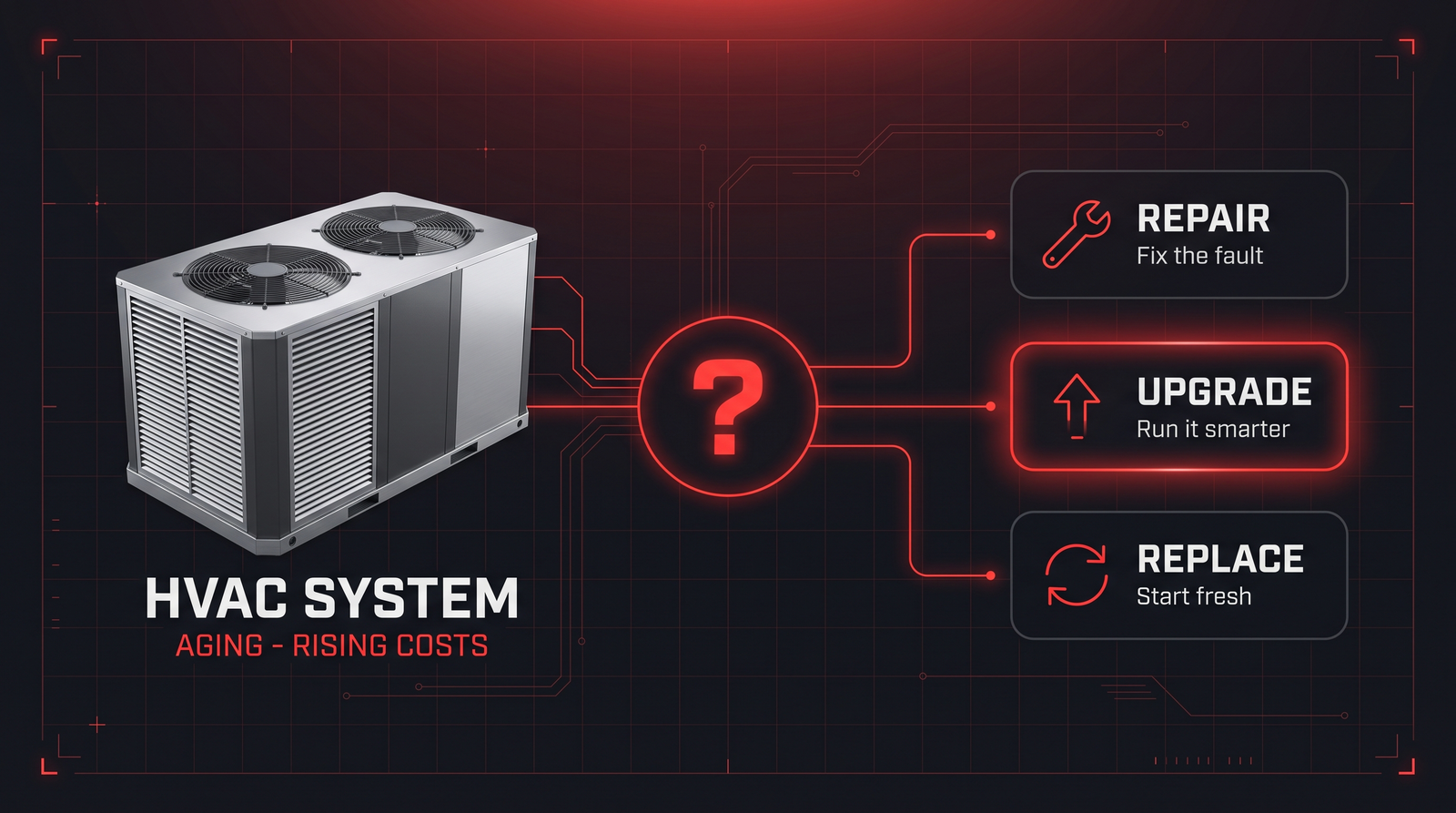
When a commercial HVAC system starts costing you money, you have three moves, not two. Repair keeps the equipment and fixes the fault. Upgrade keeps the core machine but makes it run smarter and cleaner — new controls, drives, filtration, coil protection. Replace starts over with modern, higher-efficiency equipment on today's refrigerant. The right choice is decided by a short list of indicators: age against expected life, the repair cost as a share of replacement, how much the unit wastes in energy every month, whether it still runs an old phased-down refrigerant, and what a mid-summer failure would actually cost your building. This guide walks each one — and shows how ABC Mechanical runs the math before anyone touches a wrench.
The decision most owners get backwards
The most expensive way to run a commercial HVAC system is to make the repair-or-replace decision one breakdown at a time. A unit fails, a price gets quoted, the check gets written, and the building moves on — until it fails again. Each individual repair looks reasonable in isolation. Added up over two or three summers, they often cost more than a new, far more efficient system that would have paid part of its own way in energy savings.
The fix is to stop treating it as a yes-or-no repair question and start treating it as a three-way decision made against numbers you can see in advance. Repair, upgrade, or replace is not a judgment call you make in a panic on the hottest afternoon of the year. It's a planning decision, and the indicators that drive it are knowable long before the compressor gives out.
The five indicators that decide it
Across chillers, rooftop units, split systems, and air handlers, the same handful of signals do most of the work. None of them decides alone — but together they point clearly.
1. Age against expected service life
Every class of equipment has a realistic life expectancy, and in South Florida you shade all of them down. A packaged rooftop unit might be rated for 15–20 years, a split system for 12–15, a chiller for 20–25 — but salt air, year-round runtime, and relentless humidity erode those numbers, especially near the coast. Our piece on why AC units die faster within five miles of the beach covers how much. As a rule, equipment in the first third of its life is a repair candidate almost regardless of the fault. Equipment in the last third is a replacement candidate almost regardless of how "fixable" the current problem is, because the next failure is already on its way.
2. Repair cost as a share of replacement
This is the number most people underuse. The classic guideline is the 50 percent rule: when a single repair approaches half the cost of new equipment, replace instead. A companion test multiplies the repair cost by the unit's age — a high number says the money is going into a machine that won't return it. In commercial settings we usually set the bar lower than 50 percent, because a business-critical unit carries costs a homeowner's system doesn't: lost productivity, tenant complaints, spoiled inventory, and the risk that the "repaired" unit fails again in August at emergency rates.
A repair that fixes today's fault but leaves five more aging parts one heat wave from failure isn't a fix — it's a deposit on the next emergency. Judge the whole machine, not the one part that broke.
3. What the system wastes every month
An old unit doesn't just risk failure — it quietly overspends on energy every hour it runs. Efficiency ratings have climbed sharply: a rooftop unit or chiller from fifteen years ago can use 30–50% more electricity than a current high-efficiency model doing the same work, and it does it in the most expensive way possible during a South Florida summer. If a unit is both old and inefficient, the energy penalty alone can justify replacement, because a new system pays back a real slice of its cost every month on the power bill — a dynamic tied directly to the demand charges that punish inefficient peak cooling.
4. Refrigerant — and the phase-down
Refrigerant is now a first-tier factor, not a technicality. Under the federal AIM Act, high–global-warming-potential refrigerants are being phased down: R-22 is long gone from new equipment, and R-410A is on its way out, with new commercial equipment moving to lower-GWP A2L refrigerants such as R-454B and R-32. An older system isn't illegal to keep running, but as the old refrigerant gets scarcer it also gets more expensive, and a big refrigerant-side repair on an aging R-410A or R-22 machine can cost more than it's worth. When refrigerant is the fault — a failed compressor, a major leak — that's often the moment the phase-down tips a borderline unit into the replace column, on modern refrigerant that will be supported for decades.
5. The cost of downtime
The last indicator isn't about the equipment at all — it's about the building. A unit serving a server room, an operating suite, a data-sensitive lab, or a fully leased tower carries a downtime cost that dwarfs the repair bill. When redundancy is thin and a failure means the building goes down, the calculus shifts hard toward proactive replacement or, at minimum, upgrading to add redundancy and monitoring. A cheap repair that leaves you one component away from a shutdown is not cheap. This is the same logic behind the N+1 redundancy that keeps large buildings comfortable on a design day.
The forgotten middle: upgrade
Most articles frame this as repair versus replace and skip the option that's often the smartest spend of all. Upgrading keeps mechanically sound equipment in place but fixes what's actually holding it back — efficiency, control, and capability — for a fraction of full replacement. It's the right move when the "bones" of the system are good but the way it runs is stuck in the past.
What an upgrade can add, without ripping out the plant:
- Variable-frequency drives on fans and pumps, so motors ramp to the load instead of running full-tilt and throttling — often the single highest-return energy retrofit. ABC installs Johnson Controls drives for exactly this.
- Modern controls and building automation that stage equipment intelligently, tune setpoints, and alarm a problem at 2 p.m. Tuesday instead of during a Saturday-night failure — the case we made after our controls and automation training day.
- Indoor air quality improvements — UV systems, bipolar ionization, better filtration — that a school or medical facility can add to existing air handlers. This is where brands like Fresh-Aire UV and Phenomenal Aire earn their place, a topic we cover in indoor air quality in South Florida schools.
- Coil coatings and corrosion protection — Bronz-Glow and microchannel coil upgrades that buy back the years salt air steals from coastal equipment.
An upgrade often buys most of the benefit of replacement — lower bills, better comfort, fewer failures — while deferring the capital cost of new equipment until the timing suits your budget cycle.
Green technology is now part of the money math
Efficiency and "green" used to be a nice-to-have bolted onto the end of the decision. They're now central to it, because the efficient choice and the cheap-to-run choice are the same choice. High-efficiency chillers and rooftops, variable-speed everything, heat-recovery and water-source systems like Bosch Florida Heat Pump units, economizers that use cool outside air when it's available, and low-GWP refrigerants all pull in the same direction: lower operating cost and a smaller footprint. Utility rebates and federal incentives for high-efficiency commercial equipment can further narrow the gap between "repair the old one" and "replace with a better one." When you price a replacement, price it on total cost of ownership over ten years — energy, maintenance, refrigerant, and downtime — not just the sticker.
How ABC Mechanical runs the decision
We don't lead with a product. We lead with the building. Before recommending repair, upgrade, or replacement, ABC Mechanical looks at the equipment's true condition and remaining life, your repair history and what it's trending toward, measured or estimated energy performance against a modern equivalent, the refrigerant and its phase-down exposure, and what a failure would actually cost your operation. Then we put the three options side by side with real numbers.
When replacement or an upgrade is the answer, we specify equipment to the application, not to whatever's on the truck — that's why ABC is certified across a deep bench of manufacturers: York and TempMaster rooftops and split systems, Hitachi VRF, Quantech and Thermal Care chillers, Krueger air handlers, Bosch Florida Heat Pump water-source units, Wilo pumps, Johnson Controls drives and controls, Camus boilers, Evapco-Alcoil coils, and indoor-air and protection lines like Fresh-Aire UV, Phenomenal Aire, and Bronz-Glow. The brand follows the requirement; it never leads it. For owners planning past a single unit, this same analysis rolls up into the longer view in our capital-planning primer.
The best repair-or-replace decision is the one you make on a calm morning with the numbers in front of you — not at 2 p.m. in August with a dead compressor and a building full of complaints. See the full scope of our commercial HVAC services across South Florida — Fort Lauderdale, Miami, and the Palm Beaches.