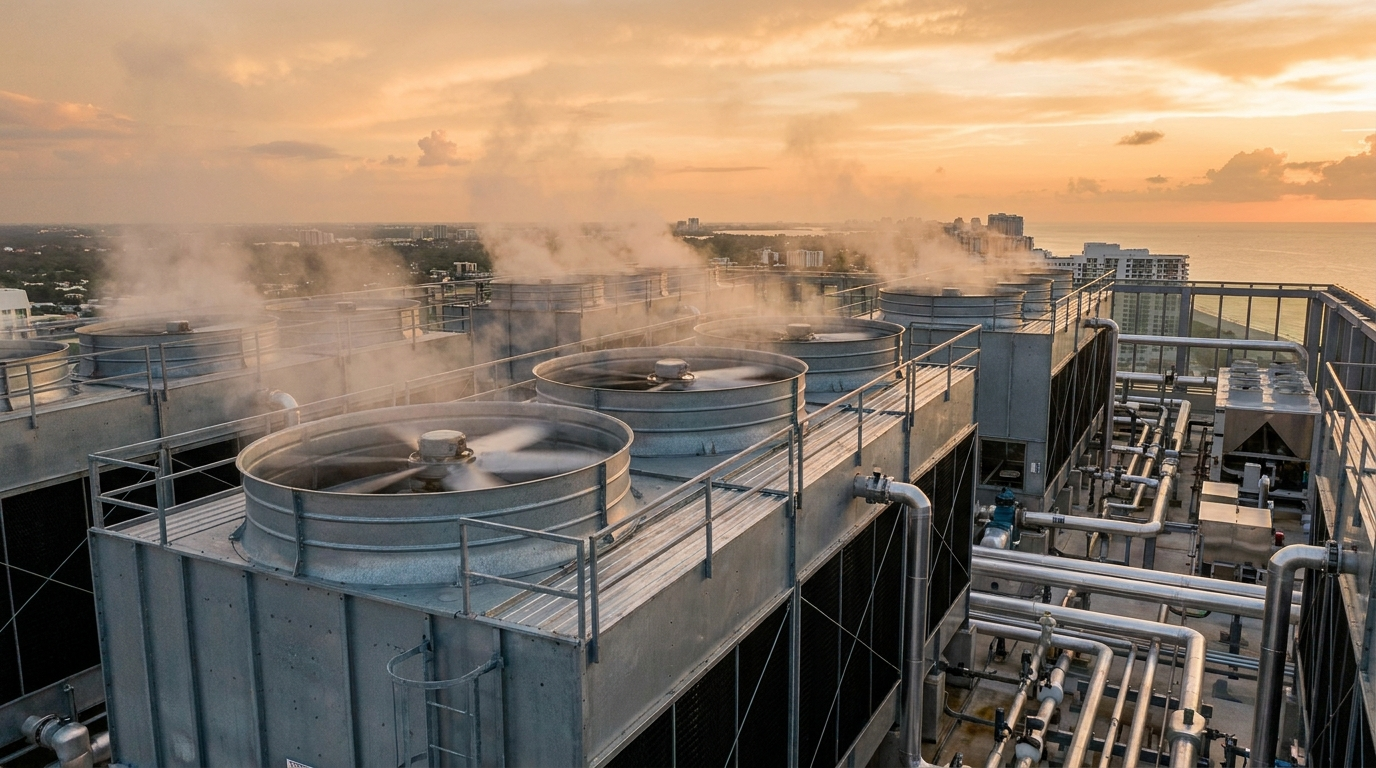
A cooling tower moves building heat by evaporating water into the outdoor air. When that water is not properly maintained, it can also aerosolize Legionella bacteria and carry it for distances measured in city blocks. Poorly maintained towers are the most common identified source of community Legionnaires' disease clusters — and the 2026 Upper East Side cluster in Manhattan is the latest confirmation. This is a condensed summary of our white paper; the full report, with every figure sourced, is available above as a PDF.
A cluster that grew sevenfold in four days
On July 2, 2026, the New York City Health Department opened an investigation into a likely community cluster of Legionnaires' disease in the Upper East Side neighborhoods of Carnegie Hill and Yorkville. It began with two confirmed cases. The city normally waits for three before declaring a cluster, but it moved earlier to find the source — and the decision was quickly validated. By the evening of July 4, the department reported 14 confirmed cases and expanded the investigation from two ZIP codes to three.
Health officials identified a rooftop cooling tower as the likely source and began sampling every tower in the vicinity. They emphasized that the disease does not spread person to person, and that it was still safe to drink tap water, shower, and run air conditioners — because tower mist blows outward and does not enter a building's plumbing. The contrast with the prior summer is why the urgency was warranted: in 2025, a Legionnaires' outbreak in Central Harlem sickened 114 people, hospitalized 90, and killed 7, with the strain matched to cooling towers.
The finding that reframes everything: chemical water treatment is necessary, but it is not sufficient on its own. Legionella colonizes scale, sediment, corrosion, and biofilm inside the tower. Those conditions are governed by the mechanical health of the system — basin cleanliness, fill and drift-eliminator integrity, fan and pump performance, and the absence of stagnation. A tower can pass a chemistry check and still put occupants at risk if it is mechanically neglected.
What Legionella is, and why the mist matters
Legionnaires' disease is a severe pneumonia caused by Legionella bacteria. People become infected one way only: by breathing in small water droplets that carry the bacteria into the lungs. It is common in natural fresh water at harmless levels and becomes dangerous when it enters a warm, slow-moving building water system with surfaces to colonize — scale, sediment, rust, and biofilm. Inside a neglected tower, the bacteria multiply rapidly and shelter within the slime layer, where they resist disinfectant.
A cooling tower is engineered to break water into fine droplets and release them as vapor. If the water carries Legionella, those droplets become an airborne aerosol that can drift well beyond the building. Roughly 1 in 10 people who contract Legionnaires' disease die from it — about 1 in 4 when it is acquired in a healthcare facility. Highest risk falls on adults 50 and older, smokers, people with chronic lung disease, the immunocompromised, and residents of long-term care.
A problem that is getting worse, not better
Legionnaires' disease is a nationally notifiable condition, and CDC surveillance shows reported incidence rising roughly 5.5-fold from 2000 to its 2018 peak — the sharpest sustained increase of any reportable respiratory infection. And the real number is higher: the disease is hard to distinguish from other pneumonias and requires specific testing that is often not ordered, so it is chronically underdiagnosed. Nearly all reported patients are hospitalized, and close to half require intensive care.
Florida leads the nation — and South Florida is built for it
Florida's outbreak burden is disproportionate. In 2020, the state accounted for close to 60 percent of all reported U.S. Legionnaires' outbreaks, and 38 percent of outbreaks in healthcare facilities. Its 2024 reported rate of 2.7 per 100,000 sits at the level of the national 2018 peak. This is not theoretical: in December 2025, Orange County reported the most legionellosis cases in the state's thirty years of record keeping.
South Florida carries elevated structural risk because climate, building stock, and population compound rather than add. Legionella multiplies between 77 and 113°F, and Miami-Dade and Broward tower water rarely leaves that band — so systems here never get the winter reset that idles northern towers each year. Continuous cooling load means continuous aerosol generation and uninterrupted biofilm buildup. High humidity helps drift stay airborne and travel farther. A dense stock of condominium, hospitality, office, and healthcare towers sits beside one of the country's largest populations of adults over 65 — the group carrying the most cases and the highest fatality risk.
The bottom line for owners: in South Florida there is no low season for cooling tower risk. Maintenance discipline is the one variable a building owner fully controls.
The six conditions that turn a tower into a hazard
A tower becomes dangerous when the same features that reject heat start sheltering and broadcasting bacteria. Six conditions do the damage: biofilm, the slime layer that shelters Legionella from disinfectant; scale, mineral deposits that insulate bacteria and cut efficiency; corrosion, whose rough surfaces harbor bacteria and release nutrients — accelerated by coastal salt air; sediment in the basin, a nutrient-rich reservoir; stagnation in dead legs and idle cells, where colonization concentrates; and weak treatment, which lets all of the above compound between service visits. Degraded drift eliminators — the last physical barrier before aerosol reaches the air — multiply the exposure when any of this is present.
Treatment and mechanics are two halves of one system
A properly managed water program does four things at once: it protects heat-transfer surfaces and extends equipment life, preserves efficiency by preventing scale, keeps the system in regulatory compliance, and protects public health by suppressing bacterial growth. That means oxidizing and non-oxidizing biocides to kill bacteria and penetrate biofilm, corrosion and scale inhibitors to protect surfaces, and conductivity control with automated blowdown to hold chemistry in range.
But biocide cannot reach bacteria sheltered inside scale, sediment, and biofilm on neglected mechanical surfaces. The CDC's engineering controls are mechanical, not chemical: operate at the lowest practical water temperature, maintain high-efficiency drift eliminators, locate towers at least 25 feet from air intakes, flush low-flow runs weekly to eliminate stagnation, automate dosing and monitoring, and perform a full offline disinfection at least annually. Water treatment and mechanical maintenance are two halves of one system — and a failure in either half creates risk.
Legionella control is now a documented obligation
ANSI/ASHRAE Standard 188 sets the minimum requirements for managing Legionella risk across the design, operation, and maintenance of building water systems. Any building with a cooling tower falls within its scope and must develop a documented Water Management Program — a water management team, a system inventory, a hazard analysis, defined control limits, monitoring, corrective action, and verification. The standard is not aspirational: CMS requires Medicare-certified healthcare facilities to comply, and jurisdictions including New York reference it directly in law.
New York shows where regulation is heading. After a 2015 outbreak, the city enacted Local Law 77, requiring every tower to be registered, inspected every 90 days, cleaned at least twice a year, and tested. After the 2025 Central Harlem outbreak, Local Law 159 took effect in May 2026 and increased Legionella testing from quarterly to monthly. Florida has no equivalent statewide registry — which is precisely why a disciplined, self-imposed program is the differentiator for a responsible South Florida building owner. The failures are almost never knowledge gaps; they are documentation and accountability gaps. Liability follows the paperwork, and after an outbreak the first thing produced in discovery is the maintenance record.
Where ABC Mechanical fits
Water treatment providers manage chemistry. ABC Mechanical manages the mechanical condition that chemistry depends on. A veteran-owned commercial HVAC contractor with more than twenty-five years of operating experience, we work alongside licensed water treatment professionals through a continuous loop — assess, document, maintain, verify, and educate — so that every element of tower operation supports equipment reliability, energy efficiency, regulatory compliance, and occupant safety. We do not replace a building's water treatment provider. We close the mechanical gap that treatment cannot reach, and we produce the documentation that proves the work was done.
The 2026 Manhattan cluster, the 2025 outbreaks in Harlem and Central Florida, and two decades of rising incidence all point to the same conclusion: cooling towers are critical public health infrastructure, and they should be maintained like it. In South Florida, where the climate keeps tower water in the growth band every month of the year, the standard of care is higher and the margin for neglect is smaller.
Every figure above is drawn from primary sources — the NYC Health Department, CDC, ASHRAE, CMS, and the Florida Department of Health — and is fully cited in the white paper. This summary is provided for educational purposes and does not constitute legal, medical, or engineering advice for any specific facility.